
Blog posts tagged "Security"

FIPS 140-2 is a set of publicly announced cryptographic standards developed by the National Institute of Standards and Technology. It is an essential part of FEDRamp requirements for many governmental agencies in the US and Canada, as well as their business partners from all around the world. Furthermore, as a well established and verifie

Smart cards have proliferated and are now everywhere, from work ID badges to credit cards and passports. For example, the United States Federal Government uses smart cards to control access to federal facilities and information systems because they offer an extra layer of security and respond to strict government guidelines. If used in a

Businesses looking to maximise the security, reliability, efficiency and performance of their essential, mission-critical applications are recognising the mainframe as a robust platform for a variety of workload types. With Ubuntu on IBM Z and LinuxONE, enhanced security features, pervasive encryption and cryptographic support are leverag

Would you like to enhance your Linux security? Do you wonder what factors should be considered when evaluating your open source security from both – the infrastructure and the application perspectives? Are you keen to learn the Ubuntu security team approach? I’ve learned that CVE patching is indeed an important puzzle, but without a struc

Kata Containers can significantly improve the security and isolation of your container workloads. It combines the benefits of using a hypervisor, such as enhanced security, and container orchestration capabilities provided by Kubernetes. Together with Eric Erns from Intel, we have recently performed a webinar in which we presented the ben

Today, Intel announced a group of new vulnerabilities affecting various Intel CPUs and associated GPUs, known as TSX Asynchronous Abort (CVE-2019-11135), Intel® Processor Machine Check Error (CVE-2018-12207), and two Intel i915 graphics hardware vulnerabilities (CVE-2019-0155, CVE-2019-0154). TSX Asynchronous Abort (TAA) is related to th

Canonical is happy to announce that all community users are entitled to a free Ubuntu Advantage for Infrastructure account for access to Extended Security Maintenance (ESM) and Kernel Livepatch* for Ubuntu 14.04 LTS (Trusty Tahr) for up to three machines, and up to 50 machines for all official Ubuntu Members. ESM provides fixes for high

Earlier this month, Canonical, IBM and FinTech specialists Medici held a joint roundtable in New York for executives within the financial services sector to hear and discuss their pain points, the most prominent emerging technologies and what the future holds. Entitled ‘Graduating from FinTech to FinServ’, the roundtable was hosted by Ros
Linux security is central to each release of Ubuntu, the most widely-used Linux distribution. With Ubuntu’s predictable six-month release cycle, users know when to expect the latest upstream open source capabilities and security. Long Term Support (LTS) vs Interim releases Every two years in April, a Long Term Support (LTS) release is pub

Overall, most Linux distributions offer sane, reasonable defaults that balance security and functionality quite well. However, most of the security mechanisms are transparent, running in the background, and you still might require some additional, practical software to bolster your security array. Back in July, we talked about handy produ
Ubuntu 18.04.3 LTS has just been released. For the Desktop, newer stable versions of GNOME components have been included, as well as a new feature – Livepatch desktop integration. As usual with LTS point releases, the main changes are a refreshed hardware enablement stack (newer versions of the kernel, xorg & drivers) and a number

An upstream Kubernetes vulnerability (CVE-2019-11247) has been identified where the API server mistakenly allows access to a cluster-scoped custom resource, if the request is made as if the resource were namespaced. Authorisations for the resource accessed in this manner are enforced using roles and role bindings within the namespace. Thi

Issues have been identified in the way the Linux kernel’s TCP implementation processes Selective Acknowledgement (SACK) options and handles low Maximum Segment Size (MSS) values. These TCP SACK Panic vulnerabilities could expose servers to a denial of service attack, so it is crucial to have systems patched. Updated versions of the Linux
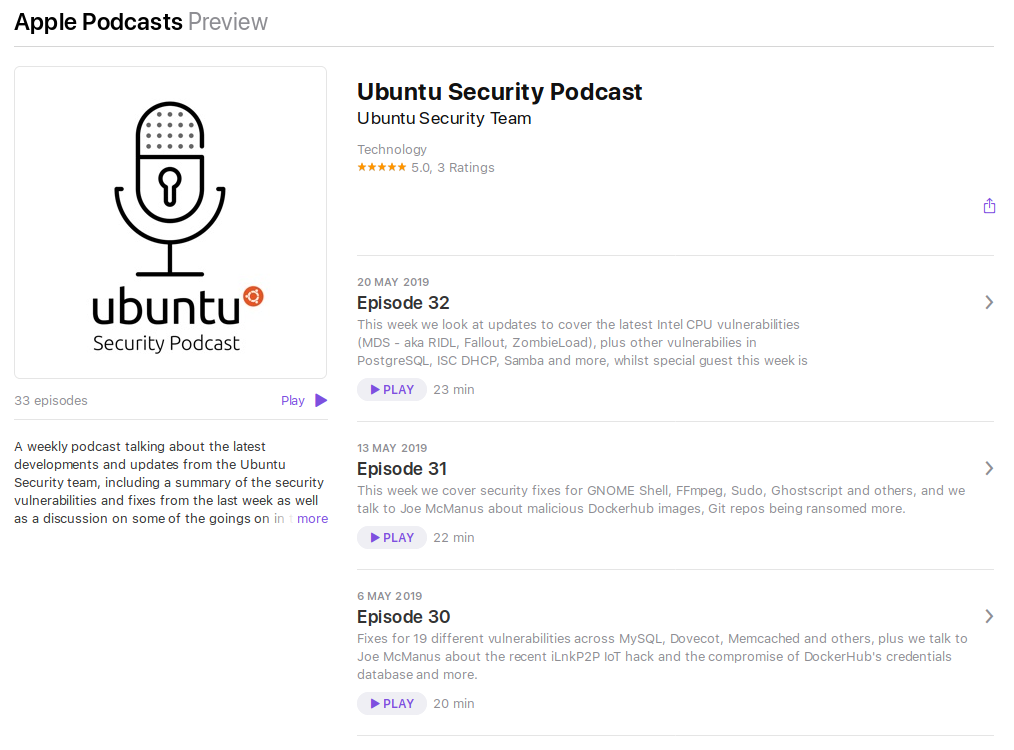
The Ubuntu Security Podcast is a weekly podcast covering all the latest news and developments from the Ubuntu Security team. Each week the team discuss the various security updates that have been published across the Ubuntu releases, describing the technical details of both the security vulnerabilities as well as the fixes involved. Due t

Microarchitectural Data Sampling (MDS) describes a group of vulnerabilities (CVE-2018-12126, CVE-2018-12127, CVE-2018-12130, and CVE-2019-11091) in various Intel microprocessors, which allow a malicious process to read various information from another process which is executing on the same CPU core. This occurs due to the use of various m
Extended Security Maintenance (ESM) is now available for Ubuntu 14.04 LTS to provide ongoing security patches for high and critical CVEs for UA Infrastructure customers.