

We have given our monochromatic icons a small facelift to make them more elegant, lighter and consistent across the platform by incorporating our Suru language and font style. The rationale behind the new designs are similar to that of our old guidelines, where we have kept to our recurring font patterns but made them more
We are updating our Intellectual Property Rights Policy to clarify the relationship between this policy and the licences of the constituent works in Ubuntu. Specifically, we are adding a single clause which states: “Ubuntu is an aggregate work of many works, each covered by their own licence(s). For the purposes of determining what you c
PreambleDelivering your Charms to the community can seem like an uphill climb when youhave minimal and manual testing around your project. The ~charmer review process ispretty rigerous and as anyone who has run the Gauntlet to attain ~recommendedst
Canonical is excited to announce that Meteorite BI has joined the Charm Partner Programme. Canonical’s Charm Partner Programme helps solution providers make best use of Canonical’s universal service modelling tool, Juju; enabling instant workload deployment, integration, and scaling at the click of a button. Meteroite BI will be contrib
To celebrate the Developer Edition Ubuntu phone launch in China, Canonical organized a “celebrate Ubuntu” hackathon for the phone in Beijing. It was also hosted as part of the on-going China Mobile & Ubuntu Developer Innovation Contest, where all projects that were coded during the hackathon were able to be submitted into the contest afte
Canonical’s cloud business continues to grow at great speed. Driven by the adoption of Ubuntu as the preferred operating system at both the infrastructure and guest level, partners and customers alike value the automation, interoperability, ease of use and professional services that we offer. We provide the fastest, most reliable, most up
Announcing Third Party Support for the DNS CharmTo anybody that followed the DNS charmdevelopment last year I had a lofty goal of introducing a third party pluginframework, which allows the user to specify a third party DNS server, andreconfigures
Using Juju in Docker for your projectsEarly this year the juju-solutions team has been experimenting with Juju inDocker – namely for isolation, and portability reasons. The Vagrant image givesa nice isolated and rebuildable environment – however the

Newsletter signup
Lime Microsystems builds open source hardware chips to enable any type of wireless communication, called software defined radio. Elre-robotics makes app-enabled open source drones with Snappy Ubuntu Core. Are you able to create flying mobile base stations? That is exactly what Lime did with an Erlecopter. Imagine emergency or military ad-
Canonical is proud to introduce one of the most exciting, on-demand, usage-based consumption models yet – and it’s for our managed private cloud service, BootStack. While public cloud, consumption-based pricing has changed the economics (for the better) of how companies and individuals procure compute resources, private clouds have contin
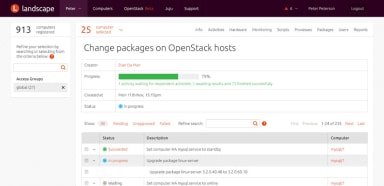
In complex computing scenarios, creating a holistic or unified update procedure across multiple clouds and hundreds of separate machines feels like an impossible task. And what do you want to do when your systems estate reaches the thousands, is it possible to automate and simplify cloud management so that thousands of systems can be mana
Lenovo to start shipping Ubuntu preloaded laptops in India starting with the Thinkpad L450 This marks the first joint launch for Canonical and Lenovo in India; building on the strong momentum Ubuntu has already achieved in the region Devices to be largely sold through selected commercial resellers/distributors across India Lenovo will be
Canonical sent three Juju Ecosystem developers and one Juju core developer to Dockercon 2015 in San Francisco during which we participated in a multi-company hackathon team; threw a marketing event featuring industry luminaries; and made connections with many potential charm authors and partners. We learned loads, preached a lot of good J
Canonical is excited to announce that Incubio, one of the top three Big Data incubators in the world, has joined the Charm Partner Programme. Canonical’s Charm Partner Programme helps solution providers make the best use of Canonical’s universal service modeling tool, Juju; enabling instant workload deployment, integration, and scaling on
I joined Canonical a year ago to work with the telco ecosystem – Network Operators, Communication Equipment Providers and innovative new players and startups interested in expanding or building their presence in the telco domain. During this year we have worked on many projects focused on the deployment of Virtual Network Functions in clo
While some work remains to be done for ‘lxc publish’, the current support is sufficient to show a full cycle of image workload with lxd.Ubuntu wily comes with systemd by default. Sometimes you might need a wily container with upstart. And to repeatedly reproduce some tests on wily with upstart, you might want to create a container image
Ubuntu tech blog
Deep dives for developers
Visit the Ubuntu Tech Blog for deep dives into product features, step-by-step tutorials, and the latest updates from Canonical's engineering teams.