
As a key technology partner with NVIDIA, Canonical is proud to showcase our joint solutions at NVIDIA GTC again. Join us in person at NVIDIA GTC on March 18-21, 2024 to explore what’s next in AI and accelerated computing. We will be at booth 1601 in the MLOps & LLMOps Pavilion, demonstrating how open source

In December 2023, Canonical joined the Sylva project of Linux Foundation Europe to provide fully open-source and upstream telco platform solutions to the project. Sylva aims to tackle the fragmentation in telco cloud technologies and the vendor lock-in caused by proprietary platform solutions, by defining a common validation software fram
Collaboration to benefit communication service providers and business application vendors at the telco edge Barcelona, Spain. 28 February 2024. Canonical today announced an expansion of its relationship with Amazon Web Services (AWS) to make Real-time Ubuntu available to Amazon Elastic Kubernetes Service Anywhere (Amazon EKS Anywhere) cus
27 February 2024: Today, Canonical announced the release of Charmed Kafka – an advanced solution for Apache Kafka® that provides everything users need to run Apache Kafka at scale. Apache Kafka is an event store that supports a range of contemporary applications including microservices architectures, streaming analytics and AI/ML use ca

tldr; Our Open Documentation Academy starts this week with our first weekly Documentation Office Hours on Friday 1st March 2024 at 16:00 UTC. Everyone is welcome! Keep reading, or see our forum post for more details and to leave questions. Many of us at Canonical wouldn’t be here if it wasn’t for Linux and open

In our ongoing exploration of Rust and Ubuntu, we delve into an experimental kernel project that leverages these technologies to create new schedulers for Linux. Playing around with CPU scheduling policies has always been a dream for many kernel hackers and OS enthusiasts. However, such material typically remains within the domain of a fe

Use open source Ceph storage to fuel your AI vision The use of AI is a hot topic for any organisation right now. The allure of operational insights, profit, and cost reduction that could be derived from existing data makes it a technology that’s being rolled out at an incredible pace in even change-resistant organisations.
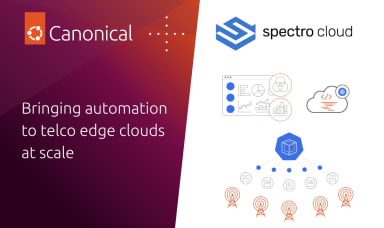
Canonical and Spectro Cloud have collaborated to develop an effective and composable telco edge cloud solution, which is built with Canonical’s open source infrastructure solutions and Spectro Cloud’s Palette containers-as-a-service (CaaS) platform. This technology stack empowers operators to benefit from the cost optimisation and agility

Newsletter signup
Kubernetes is the open source, industry-standard platform for deploying, managing and scaling containerized applications – and applications on Kubernetes are easier with operators.

In the early 2010s, Apache Hadoop captured the imagination of the tech community. A free and powerful open source platform, it gave users a way to process unimaginably large quantities of data, and offered a dazzling variety of tooling to suit nearly every use case – MapReduce for odd jobs like processing of text, audio

Learn about Confidential AI preview on Azure with Ubuntu confidental VMs and Nvidia H100 GPUs, and explore how confidential computing in the cloud transforms AI security, ensuring utmost confidentiality and integrity for sensitive data and models.

Edge AI is transforming the way that devices interact with data centres, challenging organisations to stay up to speed with the latest innovations. From AI-powered healthcare instruments to autonomous vehicles, there are plenty of use cases that benefit from artificial intelligence on edge devices. This blog will dive into the topic, capt

In this blog, we’re exploring edge computing examples, its diverse applications and use cases, with a special focus on how Canonical’s MicroCloud fits seamlessly into this transformative landscape.
RAN has incrementally evolved with every generation of mobile telecommunications, thus enabling faster data transfers between user devices and core networks. The amount of data has increased more than ever with an increase in the number of interlinked devices. With existing network architectures, challenges lie in handling increasing work
Paris, France. 14 February 2024. United by a common goal to advance open source software in telecommunications, Firecell and Canonical will demonstrate at this year’s Mobile Wireless Congress (MWC) event in Barcelona, 5G private mobile network (PMN) solutions running on Canonical’s Ubuntu operating system. Recognising the future of Open R
Landscape has been a member of the Canonical product list for almost as long as Canonical has existed. Landscape allows administrators to manage their desktop and server instances from a single centralised portal. With the latest release of Landscape Server (23.10), we’ve introduced the ability to manage snap packages from Landscape – and
Ubuntu tech blog
Deep dives for developers
Visit the Ubuntu Tech Blog for deep dives into product features, step-by-step tutorials, and the latest updates from Canonical's engineering teams.